Today, you get to look over my shoulder and read my mail… and see one of the BIGGEST reasons why the covered call selling crowd is DEFECTING… we’re talking about a mass exodus… and learning how to trade a much safer, much better options trading strategy.
Cari Houston (C.H.), a covered call seller, called me up and asked me to give her proof that she should trade married puts instead of covered calls. She also wanted me to critique of her two covered call trades and show her how she might have done better.
Seems that C.H. made a “good” return on one trade, and lost the milk money on another… and I shared with her the FACT that she would have done much, MUCH better in this market with both of those trades had she only gotten my book a few days before.
Before I let you in on the details of my conversation with my newest convert, let me ask you which of the following you would pick, if you were given the choice. Would it be an investment with…
 limited upside win potential/high downside risk |
OR |
 UN-limited upside win potential/ limited downside risk. |
GEE… when we put it that way, the choice seems clear, right? Yet intelligent, mostly college-educated people will spend thousands of dollars for a weekend seminar… that teaches how to do the WRONG choice from the short list above.
It amazes me that folks would voluntarily choose a strategy that limits their profits while leaving the door open for big problems… like covered call selling does…
| Want to protect your portfolio/401K from market downside? yet still benefit from market upside Sign up now for the free Sketch |
…instead of limiting potential losses and leaving the upside open, like the RadioActive Trading strategy does. Sigh.
Well, I’m trying to change that. Every once in a while I get a ring from someone that’s had an opportunity to sit in on one of our twice-weekly free Webinars. I spoke with a covered call seller, C.H., on Friday, November 13th. This call will turn out very lucky for her because she “gets” what we spoke about!
C.H. understood the chief benefits of the married put position as set forth in the Webinar, but she had two PRACTICAL examples from her personal account that she wanted some perspective on.
C.H. asked me if I could prove to her that it would have been better to trade a married put on her stock picks rather than a covered call. I asked her to send me her two biggest frustrations… she had been complaining about losing too much on bad trades, and gaining too little on good trades.
| Learn how to profit from winner stocks and protect yourself from loser stocks Download free Trade Simulator now |
After listening for just a few minutes, and WITHOUT even looking up the stock symbols… I was able to tell her I could almost GUARANTEE that her experience would have been better if she had just traded both issues RadioActively.
In this first blog post, I’m going to share the first part of C.H.’s letter:
Dear Kurt, it was nice talking to you this afternoon.
Here are two trades that we discussed in our conversation:
1) CTRP 11/04/09, stock price was $57.88, STO November $60 strike at $2.30. 300 shares.
After earning report it shoot up to $73.00 range. So I have made 7.9% in about two weeks. But you are saying that i could have done better…
Okay. Let’s stop there. I did tell C.H. that both of her trades would probably have done better if she had set them up RadioActively. Then she sent me the facts.
One of C.H.’s picks went up and she made money… but not as much as she could have. On the other hand, one of her picks went down and she LOST big time. In either case, setting the trade up RadioActively would have helped her do better.
First, let’s compare the result from her WINNING covered call trade with the identical stock purchase using the RadioActive Trading method.
By the way… This is where I get the most flak from my critics. They say that buying a put LIMITS profits so much that a GOOD trader wouldn’t do it.
Well… okay. That’s what some misinformed PEOPLE might say. Let’s find out what the NUMBERS say, and you can be the judge about which strategy is better. Let’s look at the contents of the first part of C.H.’s letter mathematically.
| 11/4/09 | ||
|---|---|---|
| Buy 300 shares CTRP at | $57.88 | |
| STO 3 covered calls | -$ 2.30 | |
| NEW cost basis | $55.58 | per share |
On 11/13, with shares trading now in the $70s, C.H. couldn’t “roll” the short calls to catch more upside. So, she will likely be accepting assignment on CTRP this Friday, November 20. She’ll have to hold the stock until then, but here it what the picture is likely to be:
| 11/4/09 (projected) | ||
|---|---|---|
| CTRP to be assigned at | $60.00 | |
| Cost basis | -$55.58 | |
| Profit: | $4.42 | per share… or: |
| … $1,326 total dollar amount profit, … 7.9% profit based on original investment, … 181% “annualized” return. |
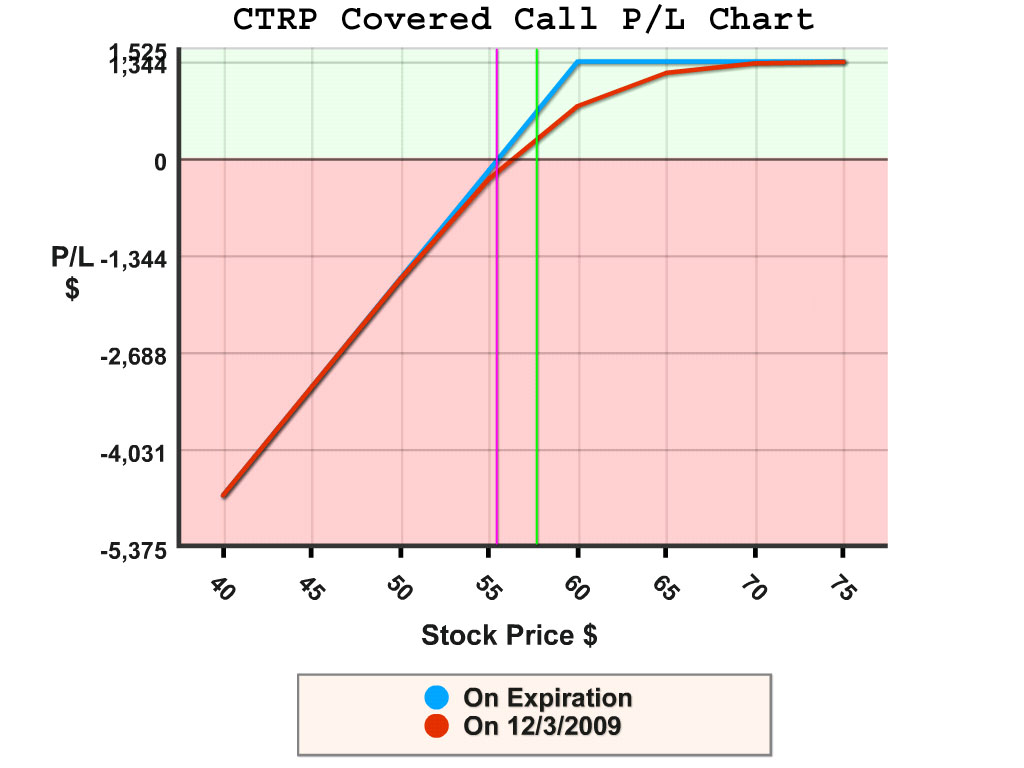
I expressed this profitable trade four different ways: per share, total dollar amount profit, profit as a percent, and percent “annualized” return– because that’s the way a lot of these covered call options trading gurus show it.
By the way, I think the “annualized” percent thing is a dishonest way to inflate projected returns… This figure is calculated by taking the percent profit, multiplying by 365, and dividing by the number of days in the position.
| Learn to trade like the pros Signup for free Webinars now |
Since in this case C.H.’s CTRP covered call trade was on for 16 days, the 7.9% profit can be expressed as 181% “annualized”.
Again, I don’t think this is the most honest way to express returns. However, since the covered call guys like to show it like that… we’ll also express the married put result the same way. Just this once 😉
SO, C.H. is looking at a 181% “annualized” return from doing covered calls on a volatile stock that she’s bullish about. Of course, let’s not forget that we’re assuming that over the next week, CTRP won’t experience a sudden DROP and turn into a LOSS. Because she has sold a covered call, C.H. is OBLIGATED to hold onto the stock for another week… and bear the risk that goes with owning volatile stock. So cross your fingers for her, she ain’t out of the woods yet.
Okay. Back to the comparison. C.H.’s big complaint about her winning covered call trade is that she can’t take part in CTRP’s upward spike past $60.
Let’s look at how we would have set up CTRP, had we followed the guidelines of The Blueprint and kept the risk down to single digits percents for several months:
| 11/04/09 | ||
|---|---|---|
| Buy 300 shares CTRP at | $57.88 | |
| BTO 3 Jun 2010 $65 puts | +$13.70 | |
| Total Invested | $71.58 | |
| Guaranteed EXIT | -$65.00 | |
| Total Amount AT RISK | $ 6.58 | or 9.19% |
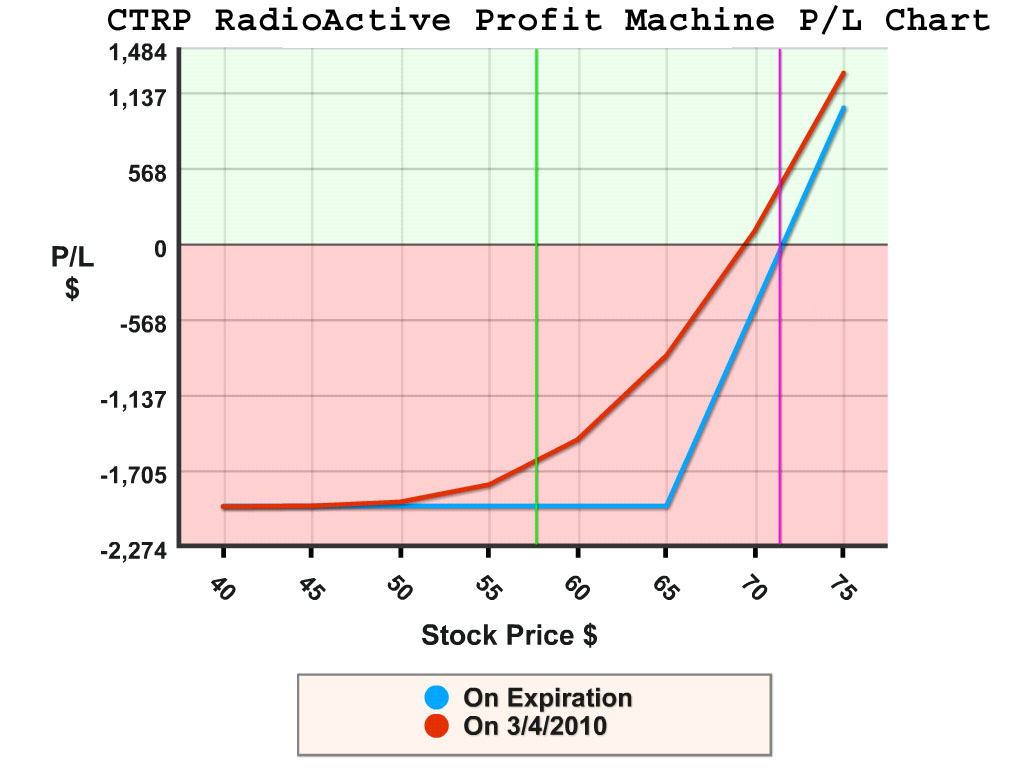
CTRP has gone up pretty high. This is how C.H. COULD have ended the position today (11/13/09) had she set it up RadioActively in the first place:
| 11/13/09 | ||
|---|---|---|
| 300 shares CTRP now | $72.19 | |
| STC 3 Jun 2010 $65 puts | +$ 7.70 | |
| Total position value | $79.89 | per share |
| Minus Cost Basis | -$71.58 | |
| Profit | $8.31 | per share… or: |
| … $2,493 total, … 11.6% based on original investment, … 470% (!) “annualized” |
Now, ANY way you slice it the above trade would have been better than buying stock and selling a covered call.
Instead of buying stock and selling a call, if C.H. had bought stock and also an in-the-money put, seven months out… she would have done MUCH better: $3.89 better per share; $1,167 better as a dollar amount; 3.7% better as an ACTUAL percent, and 289% better as one of those “annualized” returns.
That big, big difference at the end is because the position would be in place for a shorter period of time…11.6% return in nine days waaaay beats 7.9% in 16 days. Even if we simply ended the position on 11/13, without using the “Income Methods”… we still can plainly see the superiority of the married put play.
Okay, gang. In this FIRST installment, I showed how married puts outperform covered calls on the winning side. But PROTECTION is more important. When you’ve picked a loser, keeping losses down makes all the difference to your overall portfolio. Check that out in our next blog article on “Why So Many People LEAVE the Covered Call Strategy… and What They are Doing INSTEAD”.

 I'm Kurt Frankenberg, and I have discovered how to truly put the odds on the side on the individual investor.
So why not just have a set a protective stop and save the money paid for the puts? I guess that you limit your downside if you aren’t around a computer to watch a position. However, you are making a directional trade anyway and you dilute the profit by buying the puts. I do understand how stops can end up being filled wider than you thought on a spike, but how many times does this need to happen, vs. not only having the stock go up, but having it go up enough to cover the cost of the puts?
Hi Kurt,
The only reason I have enough capital to trade with is because I found your married put strategy. Luckily I paper traded when I started and a stock gapped down (TRA) I rented it at about $50 and it ended up going doooowwwwwwn to $11 and is only now starting to get back to $38 so I went looking for a better way.
ALL my trades are radio active trades, I do it manually at the moment and can sleep at night knowing my portfolio is protected from bad news, while having unlimited upside potential. I paid $2999 for a “guru” course for “renting shares” and when I went back to a few meetings many traders that were trading live had been burned and their trading capital had been smashed from recommendations
I have learned more from PowerOptions and Kurt Frankeburg’s free webinars and recordings than the course I paid for. The simplicity of your explantions is fantastic and very much appreciated.
I would like to say thank you Frank for being out there doing what you are doing for traders, you gave me the confidence I needed to put real money into the markets.
Regards,
Peter
Hi
I purchased your “blueprint” some time ago. It was interesting but I have stuck to my style of covered call investing. My trailing 12 month returns (actual) are 31%. And that includes one of the worst stock market stretches in two generations.
As far as the above comparision goes. . . you are comparing apples to oranges (but I think you know that). “CH” had set up a covered call position and you are comparing it to a long stock position with a married put for protection. It’s not the same strategy. A more accurate comparison would have been if you added the sale of a call in your position to mirror her set up. If “CH” had set up a long stock position as you had done she would have had a far superior return because she would not have had the cost of the put. Granted, she would have no downside protection though.
I’m one of those “covered call guy’s” who use annualized return as a means of comparision. I agree, this is not comletely accurate, but one must have a basis for comparision. I have found this to be the “most” accurate way.
As I said, I find your literature interesting and thought provoking. Keep up the good work.
Jim Rack
Reply to Scott:
Well… Good question, why not just place a stop?
You can probably think of the obvious: too tight of a stop you will be prone to getting stopped out, and too loose you don’t have enough protection.
But there’s a BIGGER problem called GAPS. Very recently I was publicly trading DRIV. While DRIV gapped down about 35% overnight, my put option insured me so that MY loss was 5.7%… way better than any stop order could have done to protect me.
I just had a letter from Australia in which one of my subscribers said that the only reason he has ANY capital to trade is because he’s in married put positions.
Thanks for writing. Hope you have Happy Trading instead of GAPPY trading!
Kurt
Reply to Peter:
Thanks for writing again mate! Appreciate your comments and had them posted for Scott’s benefit above.
Write me anytime with questions about the method or ideas for how one might manage various positions. Are you using RadioActive Trading with the Australian market or American?
Happy Trading,
Kurt
Reply to Jim:
Congratulations. I’m impressed with your trading record!
Regarding comparing apples to oranges… uh, YEAH. I’m highlighting the DIFFERENCES between adding a long put option to stock and adding a short call to stock.
Each move… buying a put or selling a call… reflects a bearish thought. When used in context with long stock, they are hedges.
I’m just pointing out that a long put hedge is often more effective than a covered call hedge whether your stock goes up OR down. Part One of “Why so Many People Leave the Covered Call Strategy…” shows the power of leaving your upside open.
Part Two will deal with the consequences of trading long stock with a covered call if the stock CRASHES… and demonstrate how much better a long put would be to CYA: Cover Your Assets.
😉
Thanks for the blog post Jim! And thank you for picking up The Blueprint. Congratulations on your trading record. May you continue to have…
Happy Trading!
Kurt
Preservation of capital is Rule #1, so one must admit that Kurt’s ‘married put’ strategy adhere’s perfectly to this rule and yet still leaves all the upside profit potential; sure you have to pay for the protection or insurance but you do that anyways with other things like cars, houses, etc…….
I had a postions in STEC and RIMM and they both gapped down on me… It happens more than you might think….
Reply to Carl:
Right you are! I personally was cleaned out years ago when trading covered calls on margin. The gap wiped me out completely. SINCE then you can be sure that I use and teach Rule #1.
Thanks for the post, Carl. Check DRIV recently… about a 35% gap down but I closed the position with a 5.7% loss because of the put option. Gotta love staying above water so we can catch the good ones.
Happy Trading,
Kurt
Kurt
Interesting concept.
What do you use to determine which value put and which month out to purchase – is it always the next in the money put and then always seven months out?
Regards
Bill
buying stock and buying a protective put at the same time is really a synthetic call option at the same strike price and you don’t have to use as much capital.
Reply to Bill:
Not always. I usually pick a put a strike or two in the money and at least five months out. Sometimes I get one a year or two out! It just depends on the individual stock.
I use the PowerOptions platform (available for free trial at http://www.poweropt.com/rat) to do all the heavy lifting for me math-wise.
Thanks for writing!
Reply to Rich:
Now, WHY on Earth would you want to use less capital?
Would that be to leverage returns?
Of course it would be. Now, the synthetic of a married put is NOT a long call… it is a long call PLUS a commensurate amount of capital on deposit.
If you do not have the capital to risk on a married put, trading a long call in its place means you may be over-leveraged.
I have a few videos and blog articles on this subject. Feel free to submit more about this question; it’s a common misconception that trading married puts carries the same risks as trading long calls.
Happy Trading,
Kurt
One other factor though…what happens when the stock doesn’t move for months at a time? With a covered call, you profit. With a married put, you lose money. So seems to me, if you think the market is going higher but still want protection you do the married put, but if you are clueless as to market direction, take the decreased cost basis as a natural hedge and accept a capped profit as the trade off.
Yes, the married put is a BULLISH strategy. So you would employ it when you are optimistic about your stock pick going up.
If you are wrong and the stock moves sideways, there is the issue of time decay. In the case of a covered call, time decay is a positive thing.
However! I am less concerned about a sideways moving stock and more about what to do with a trending stock. If she’s covered with a married put, I have protection against a reversal, even a dramatic one.
AT the same time, I have no limit on the upside.
I’m okay with paying a little for the protection, especially because sometimes I predict a stock’s movement incorrectly 😉 and because married puts WAY outperform covered calls when a stock heads up in good steam.
Do you ever advocate marrying your married put to a way out of money bull put spread ?
You’re flirting with one of the TEN Income Methods, there. I use this with another option play to get a little extra BUMP out of a Married Put.
Most recently I did a Bull Put Spread within the context of a Married Put along with another options play to take out almost ALL of the risk with CTSH. Earnings is approaching, and I have no worries since if the news is DISASTER… I only lose 1.9%.
On the other hand, as with any Married Put trade, my upside is limitless.
Cross yer fingers with me!
Happy Trading,
Kurt
I’m printing this for future , frequent, reference ! Best, most enlightening, options conversation I ever had the luck to stumble onto
Thanks Albert! Come check out the free YouTube videos and free resources on http://www.radioactivetrading.com as well.
What type of delta do you look for on the put? Do you then sell a lower put with a closer expiration?
Delta isn’t one of the criteria we pay much attention to. But, the initial put option is less than 20% In The Money when that is coupled with low max risk numbers, we naturally get puts that range from 0.55 to 0.75. The lower max risk options will have higher delta since you are paying for more intrinsic value and the risk is only the time value portion of the option.